
When Systems Break, It’s Never the Weather - It’s the Design.
RX8: The Design Code

I’m reporting from Ibiza, where—for the second time in two weeks—flooding has paralyzed the island.
The airport shut down as runways disappeared underwater. Water seeped into terminals. Twenty-four flights were cancelled. The main motorway closed. Hotels evacuated guests. The military deployed pumps. Public transport halted. Nearly six hundred households lost power after a lightning strike.
This wasn’t weather. It was design.
Post-incident assessments show what experts have warned for years: drainage disconnected from building codes, emergency response split across jurisdictions, and tourism infrastructure planned without water management.
And it’s not new. Our neighbor island Valencia lived this story a year earlier. In October 2024, 491mm of rain fell in eight hours—232 people died, and the damage exceeded €10 billion. Analysis revealed the same root cause: highways, drainage, and response systems engineered in isolation, performing perfectly until pressure exposed the gaps between them.
Real estate is the frontline of climate resilience.
Cities like Copenhagen and Rotterdam design differently—integrating permeable surfaces, underground retention basins, and rooftop wetlands that absorb and circulate stormwater. Every square meter participates in a living hydrological network that protects billions in property value while reducing insurance and recovery costs.
Ibiza hasn’t caught up.
And the same pattern exists inside our organizations:
Supply chains collapse under disruption.
Data architectures fragment while deploying AI at scale.
ESG sits apart from operations.
Innovation teams work without integration.
This isn’t about sustainability virtue.
It’s about system resilience determining competitive position when stress arrives.
Every week, I decode one of the 9+1 RX Codes—frameworks for upgrading your organization’s operating system for the regenerative age.
This week: RX8, The Design Code—why systems built in pieces collapse under stress, and how nature’s 3.8-billion-year design intelligence shows us how to build coherence that outlasts competition for short term profit.
THE ROI OF COHERENT DESIGN
Morgan Stanley’s 2025 survey of 330+ executives: 88% of companies now measure sustainability ROI as confidently as traditional investments—with key drivers including increased profitability (25%), higher revenue growth (19%), and improved cash flow visibility (13%). Board levers: lower WACC, tighter hurdle rates, improved insurance terms.
Research from Accenture (2023) and Oxford/Arabesque confirms: 88% of companies with strong sustainability practices saw improved operational performance. ESG leaders in 2021 saw 8% higher returns than broader market (Plana Earth, 2024), with high ESG scorers receiving 10% cost of capital discounts on average (Plana Earth, 2024).
What differentiates leaders? Not better products. Coherent systems where information, resources, and decisions flow as integrated wholes—not fragmented parts.
TIMELESS DESIGN INTELLIGENCE: 3.8 BILLION YEARS OF FIELD TESTING
Every week I explore Three Living Intelligence Architectures—one from my roots, ancient Anatolia & Mesopotamia, one from tree and forest networks, and one from whales and oceanic life.
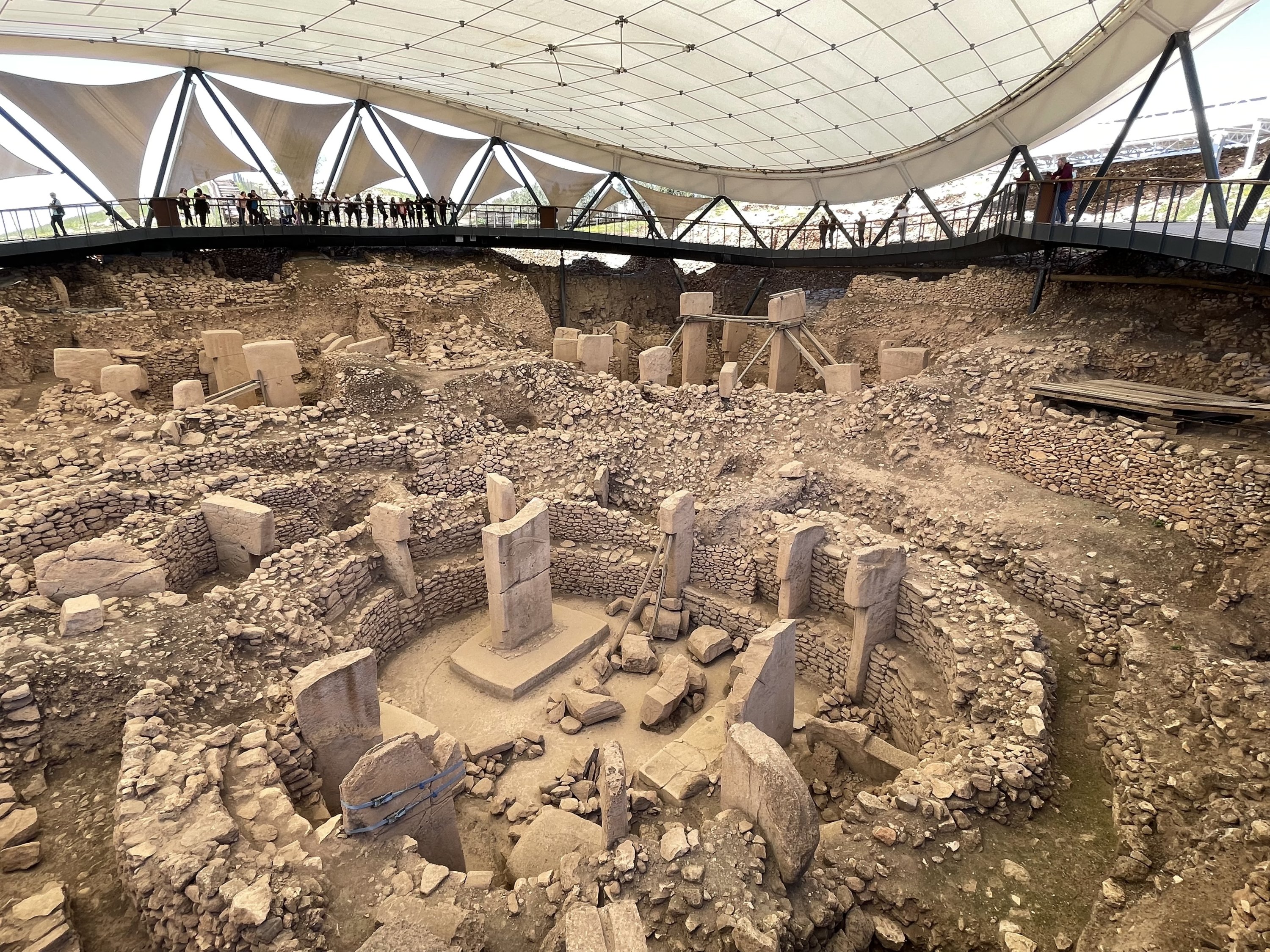
GÖBEKLI TEPE—Purpose Before Survival
11,500 years ago, hunter-gatherers with no agriculture built 50-ton limestone pillars in perfect geometric patterns (Haklay & Gopher, 2020). Research shows collective purpose came before survival optimization. Shared meaning unlocked coordination that enabled settlement, agriculture, civilization.
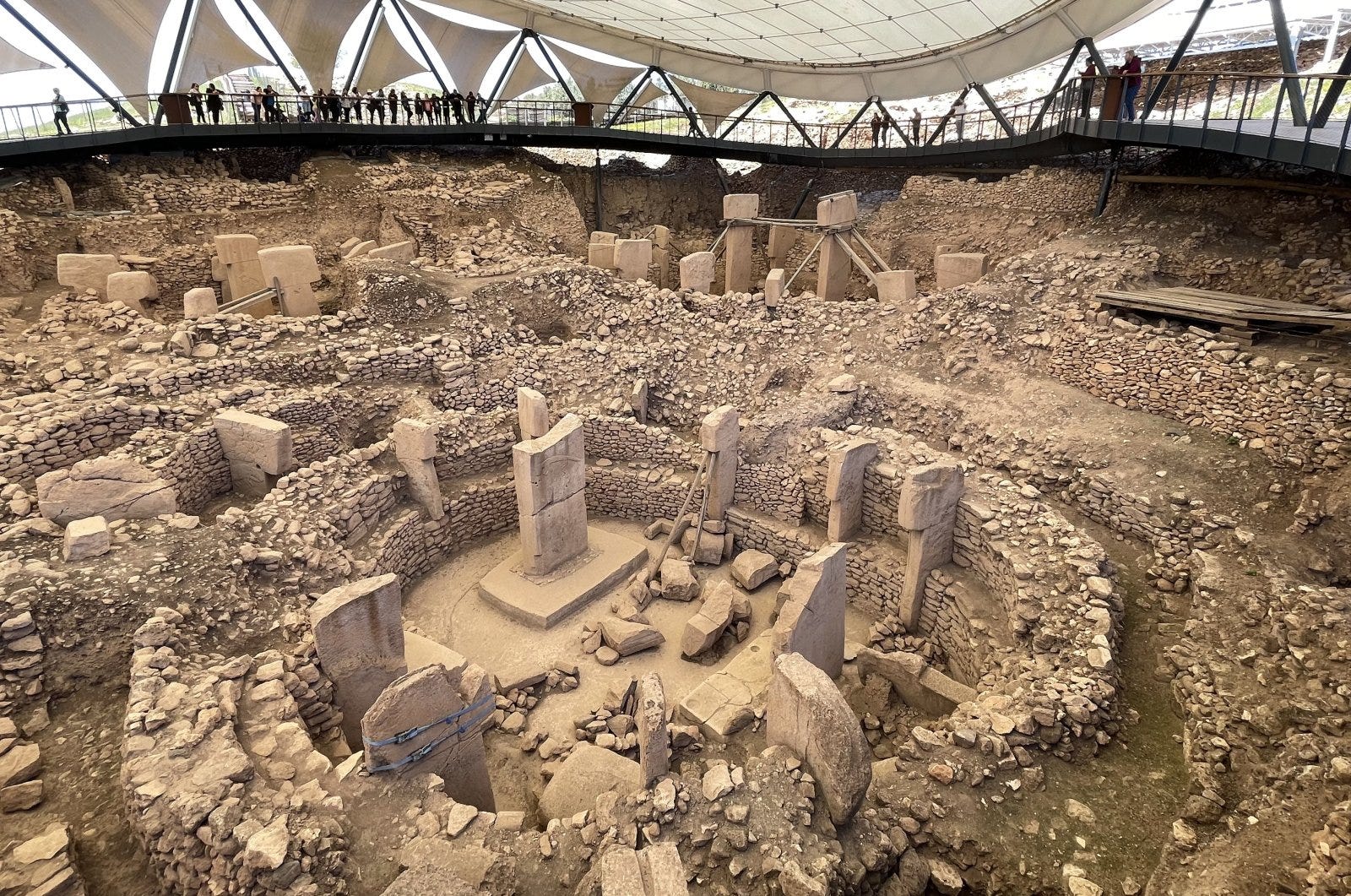
A view from Göbeklitepe, Şanlıurfa, southeastern Turkey, April 28, 2022. (AA Photo)
Business translation: Define your strategic essence (the organizational signal). Design coherence emerges when every decision aligns with the company’s deeper reason for existing beyond transactions. When this signal is explicit, structure self-organizes around it. Outcome in enterprise terms: tighter strategic alignment → faster capital allocation → fewer ‘zombie’ initiatives- “alive” on paper but dead in impact.
MYCORRHIZAL NETWORKS—Decentralized Intelligence
Fungal filaments connect tree root systems below forest floor (Simard et al., 2012). Resources share based on systemic need, not hierarchy. One tree has excess nutrients? Network distributes to struggling areas. Enables forests to survive extreme stress without central command.
Business translation: Decentralized decision rights with shared telemetry—data, talent, and capital self-organize to the highest-value edges. Distributed decision-making with unified purpose. Companies implementing this model report significant improvements in resource allocation accuracy and talent retention (biophilic organizational design research).
WHALE PUMP—Circulation Creates Abundance
Whales dive deep (1,000+ meters), surface to breathe, release waste concentrated 276,000 to 10 million times higher in nutrients than surrounding seawater (Ratnarajah et al., 2014; Roman & McCarthy, 2010). Fertilizes phytoplankton, feeds krill, feeds whales. Self-reinforcing abundance through circulation.
Business translation: The whale pump principle of self-reinforcing abundance applies when circulation is designed intentionally. Organizational byproducts—unused data, talent, or insight—become nutrient flows. Cross-functional information flow. Strategic decisions informed by front-line intelligence. Customer insights circulating upward. Result: Faster innovation cycles and reduced discovery-to-deployment time when properly instrumented.
REGENERATIVE AI: THE EMERGING ARCHITECTURE
AI deployment now determines resource consumption and system resilience for the next decade. A 100-megawatt data center uses approximately 2 million liters of water daily—equivalent to 6,500 households (IEA, 2024). ChatGPT alone uses over 500,000 kilowatts daily, as much as 180,000 U.S. households (Food and Water Watch, 2025). By 2028, U.S. data center water consumption could double or quadruple from 2023 levels (Lawrence Berkeley National Laboratory, 2024). Yet most AI strategies operate separately from sustainability and design thinking.
Design governor: Model value per kWh and per liter—prioritize architectures that increase value density, not just scale.
Regenerative approach: AI systems that restore while creating value. Emerging examples: AI discovered 2.2 million new crystalline structures vs. 20,000 previously known (Autodesk Research, 2025)—enabling more efficient batteries and solar panels. Autodesk’s AI analyzes building redesign for multiple lifecycles—optimizing simultaneously for performance AND novel net-zero materials.
MIT Sloan research (2025) shows AI increasingly demands uniquely human capabilities—empathy, ethics, purpose, vision (EPOCH framework). World Economic Forum (2024) projects 70% of skills changing over five years—toward capacities machines cannot replicate.
Business translation: Design AI to circulate through organizational layers (like whale pump), share intelligence across networks (like mycorrhizal systems), and serve unified purpose (like Göbekli Tepe). BCG (2025) data: only 4% of companies create substantial AI value—because most fragment deployment rather than designing regeneratively. Organizations with integrated AI architectures report faster implementation and reduced bias incidents (program-level averages; industry and data quality dependent).
FOUR LAYERS OF DESIGN CONSCIOUSNESS
In nature, every layer—water, soil, air, fire—serves a distinct role in the whole. In organizations, information, culture, energy, and purpose must do the same. The question is: at what level of consciousness does your design operate?
I guide leaders through 4 levels of consciousness. Most organizations die at Levels 1 and 2. The companies thriving in 2030 operate from Level 4.
LAYER 1: EXTRACTION
Each part optimized independently. Speed over coherence. Externalize costs to maximize individual function.
Cost: Valencia’s highways worked—until the flood. Ibiza’s tourism infrastructure performed—until weather exposed fragmentation. AI deployed without resource strategy.
LAYER 2: OPTIMIZATION
Fix what extraction broke. Add sustainability after. Reduce harm, don’t redesign cause.
Cost: Perpetual problem-solving within dying architecture. ESG team exists while AI deploys without resource strategy.
LAYER 3: RESPONSIBILITY
Purpose statements, stakeholder commitments. Values guide some decisions. But transformation stays siloed.
Cost: Good intentions without systemic integration. Competitive parity, not leadership.
LAYER 4: REGENERATION
Design for life itself. Every decision evaluated: Does this build capacity for all parts to realize essence—as coherent whole?
Creates: Non-displaceable advantage. Organizations that treat workplaces and workflows as living systems achieve measurable cognitive performance gains and brand differentiation and high long term impact.
Bill Reed, Regenesis: “Regenerative design works with potential, not problems. You build a new model that makes the existing one obsolete.”
RX TRANSFORMATION PATH
Phase 1: Audit for Coherence (Month 1)
Comprehensive diagnostic: Are you operating at extraction, optimization, responsibility, or regeneration? How do information, intelligence, and resources circulate? Where is purpose clear vs. fragmented?
Deliverable: Executive brief with leverage points, ROI projections, risk mitigation pathways.
Phase 2: Redesign for Circulation (Months 2-4)
Select one high-impact system. Redesign using regenerative principles—whale pump circulation, mycorrhizal networks, unified purpose.
Representative outcomes from comparable programs (internal + partner data, available under NDA):
Global automotive: Faster time-to-market for circular innovation after redesigning cross-functional flow
Tech firm: Savings through integrated data architecture preventing redundancy
Healthcare system: AI-augmented clinical judgment improving diagnostic outcomes while reducing clinician stress through proper human-machine metabolism design
Critical factor: Instrument the system end-to-end (flow time, rework, decision latency, error cost).
Phase 3: Scale Through Network Effects (Months 5-12)
Build internal capacity. Train design architects who spread regenerative thinking through demonstrated value, not mandate.
Outcome: Self-sustaining transformation. Each team becomes node in larger intelligence network.
ENGAGEMENT OPTIONS
Executive Design Intelligence Intensive → For: CEO, CFO, CHRO, CIO
3-day immersion for C-suite + board. Diagnostic across four consciousness layers, strategic redesign, implementation roadmap.
RX Codes Transformation Program → For: Transformation Office / Strategy
12-month journey across regenerative frameworks—including design code, consciousness layers, and nature’s patterns. Monthly sessions + implementation support.
Strategic Advisory → For: Operating Committee / Board Strategy Committee
Ongoing partnership for design-led transformation at scale through the four layers.
Start Here
Initial Consultation: 90-minute diagnostic to assess which consciousness layer you operate from and identify highest-leverage intervention points.
Contact: join@regeneratex.co | www.regeneratex.co
RX Design Code diagnostic: Assess your design code
Strategic consultation & team constellations: join@regeneratex.co
AI+Human Agency program enrollment
Ibiza application: Heart Masters Ibiza 2026 waitlist
Share this with someone whose organization is prepared to design in harmony with life’s intelligence.
Design determines whether systems fragment or adapt under pressure.
Nature doesn’t optimize for efficiency. It designs for resilience.
The companies defining the next era won’t just survive disruption—they’ll embody the integrated intelligence that makes fragmentation obsolete.
In Ibiza and Valencia, and all around the world, we see the cost of designing in pieces. The winners will design as coherent wholes—before the stress test arrives.

Will your organization learn the language of whale pumps, mycorrhizal networks, and organizational essence—or keep fragmenting until pressure reveals the bill?
Design is remembered intelligence. Because resilience is not built—it’s remembered from the logic of life itself.
- Canay Atalay
Mother & Founder, RX Innovation Institute
Regenerative Architect · Strategic Advisor · Author of the RX Codes
Let’s connect: Linkedin & Instagram
SOURCES
Ibiza Floods (October 2025): The Local (2025), Majorca Daily Bulletin (2025), UNN (2025), Travel and Tour World (2025)
Valencia Floods (October 2024): Wikipedia (2024), WMO (2024), NASA Earth Observatory (2024), Reuters (2024), GNDR (2024), SSPH+ Journal (2025)—491mm Chiva, 232 deaths, €10.6B government aid
Business Performance: Morgan Stanley Sustainable Signals Survey (2025), Accenture (2023), Oxford/Arabesque, Plana Earth (2024), Capgemini (2024)
AI Resources: IEA (2024), Lawrence Berkeley Lab (2024), Food and Water Watch (2025), MIT (2025), IEEE Spectrum (2025)
AI & Human Capabilities: MIT Sloan (2025), Autodesk Research (2025), BCG (2025), World Economic Forum (2024), McKinsey (2025)
Natural Systems: Haklay & Gopher (2020) on Göbekli Tepe, Simard et al. (2012) on mycorrhizal networks, Ratnarajah et al. (2014) and Roman & McCarthy (2010) on whale pump
Regenerative Design: Reed & Regenesis Group, Arup (2024), biophilic organizational design research