
Intelligence Has Been Knocking for Years. Will You Open the Door?
2026 ReCode - Issue #8

Last issue (We Had the Signal. We Didn’t Listen) I said: the constraint was never knowledge. It was connection.
This issue I want to go one layer deeper.
What you sent back points to something more specific than disconnection.
The signal has been arriving for years. In your body. In your team. In the land. In the people closest to what is breaking. It has been knocking - on the door of your strategy, your governance, your capital allocation - and your system was built to not hear it.
Not because people are not listening. Because the systems around them were not designed to receive what listening finds.
78% of companies have deployed generative AI. Over 80% report no material impact on earnings. McKinsey named this the “GenAI paradox.” The technology is not the problem. The direction is - and the architecture that determines where what is heard actually goes.*
Three layers of intelligence
You already described them in your responses. Let’s make them visible.
1. The Signal
What is felt, sensed, observed - body, team, client, community, land.
You are already here. You named it last issue.
This is the father who knows the need of his child before she speaks it. The founder who feels the issue of the company at 3am. The cooperative in Southern Spain that stopped applying for funding because the funding was distorting what they already knew worked. The land that has been reporting water table depletion for a decade.
The signal is not the problem.
The signal is everywhere.
2. The Translation
What is named, structured, made legible - pattern recognition, synthesis, language.
This is where most AI investment is currently pointed.
AI is genuinely powerful here. It can synthesize what a team has been sensing for months into a single legible pattern. It can surface what your clients are not quite saying across a thousand conversations. It can make the granular legible at scale - connecting what the cooperative in Southern Spain knows to the institutional framework that capital requires before it will move.
This layer is accelerating. It is not the bottleneck.
3. The Decision
What actually moves resources, strategy, direction - governance, capital, architecture.
This is where the door is. And almost no one has built the mechanism to open it.
Not because the decision-makers are not intelligent. Because the room where decisions are made was designed for a different kind of intelligence. Explicit. Quantified. Arrived through approved channels. And the AI that could translate it into something the table can hear is not yet connected to the governance structure that would act on it.
Layer 1: Listening → Most organizations improving here
Layer 2: Human + AI synthesis → Some accelerating here
Layer 3: Decision architecture → Very few are equipped here
And this is where advantage is decided.
Which layer did you just recognize yourself in?
This is why your AI still feels underwhelming. Not because it is not powerful.
Because it is not connected to governance, capital allocation, product architecture and leadership decision-making
You are hearing more. But your system architecture is not designed to act on what you decide based on you turning what you hear into intelligence of your own.
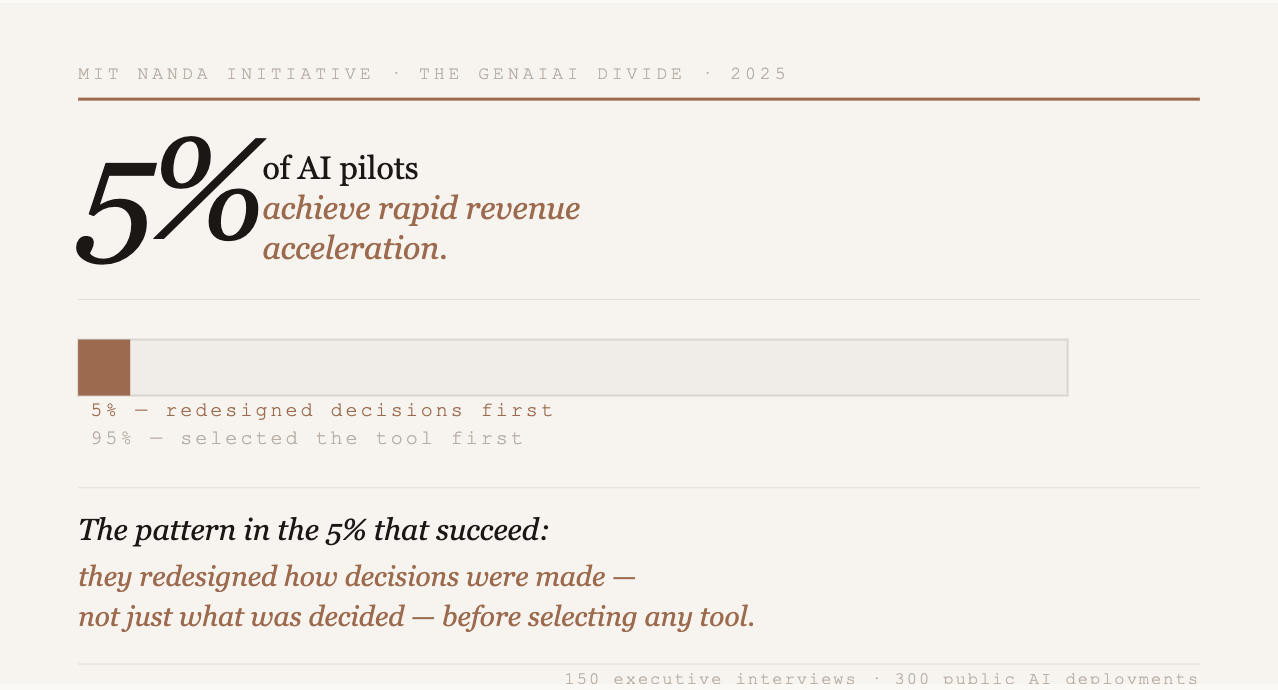
Only 5% of AI pilots achieve rapid revenue acceleration. MIT’s research across 150 executive interviews and 300 public deployments found the clearest pattern among those that succeed: they redesigned how decisions were made - not just what was decided - before selecting any tool.
A pattern emerging from your responses
Across different industries, roles, and geographies - you are all describing the same structural gap. One response stopped me. I want to sit with it.
“We can sense. We can analyze. But we cannot move fast enough - with integrity.”
That word: integrity.
Not speed. Not strategy. Integrity.
The signal and the action need to be the same thing. That is not a cultural aspiration. It is an architectural requirement. And most governance structures make it impossible by design, not by failure, but by how they were built, for a world that no longer exists.
This is not only happening in boardrooms.
It is happening at dinner tables. In marriages. In the conversation a leader keeps postponing with their child. The same code that filters out the community signal, the land signal, the team signal - runs at every scale. The codes we operate inside do not stop at the office door.
That gap is not operational.
It is systemic. And it is intimate.
What sits underneath
Something came up in nearly every response I received. You described the same experience: knowing something - and watching it disappear inside their own organization, their own family, their own life - before it could do anything.
Every organization and every person is already operating on a set of invisible codes.
These codes determine:
→ What is considered valid intelligence
→ What gets to influence decisions
→ What is ignored, even when seen
And therefore:
→ What enters strategy
→ What gets funded
→ What survives
Most of them were designed for a world where intelligence was scarce, signals were slow, and decisions were centralized.
That world no longer exists.
But the codes are still running.
In your governance structure. In your capital allocation logic. In your meetings. And yes, in how you decide what to say at dinner and what to leave until later, until there is no later.
The real cost is not missed data nor wrong strategy.
But: systematically filtering out the most important signals before they can shape reality.
At organizational scale, this looks like a BCG statistic: 60% of companies generate no material value from AI despite continued investment. Only 5% create substantial value at scale. The gap between them is not budget or model sophistication. It is whether the organization is structured to receive what its intelligence surfaces and route it to the layer where decisions actually get made.
The signal was there. The architecture was not.
Where this becomes leverage
Some of you are already moving differently.
“We started mapping what we are hearing before deciding.”
“We paused execution to understand what keeps repeating.”
“We changed how decisions are made, not just what is decided.”
This is not better listening.
This is recoding how intelligence moves through the system.
This is what opening the door actually looks like. Not a new model. Not a larger budget. A redesigned path from signal to decision, built by someone with the authority and the capacity to ask: what do we do when intelligence finally gets through?”
This is Layer 3.
This is what we are building in Türkiye - a national sensing architecture mapping leadership intelligence, community knowledge, and land data into a coherent strategic framework. AI as connective tissue. Human agency as the sensing layer. Nature as the design principle.
If it is relevant to what you are building, drop an email to join@regeneratex.co
Before you answer the questions below, one thing first.
Think of the last signal that arrived - from a client, a team member, someone you love, your own body - that didn’t make it into a decision.
Where did it stop?
Was it Layer 2 - named, even analyzed, but never acted on?
Or did it never make it to translation at all - felt, then filed, then forgotten?
Hold that location. That is not a personal failure.
That is a design problem. And design problems have solutions.
What is your body carrying that has never made it into a decision?
What signal from your community or your clients does your AI deployment not yet know how to hear?
What would change - in your organization, in your family, in how you lead - if the signals you have been filtering out finally had a place to land?
Name it in the comments below.
I will hold what comes back and let the pattern emerge before the next issue.
Art Dialogues
Art is one of the few things that can receive us before we receive it.
By now this is a ritual - at the close of every listening issue, I leave you with a piece that asks something your strategy document cannot. This week;
Doris Salcedo. Shibboleth. Tate Modern, Turbine Hall, London. 2007.

167 metres. A crack running the length of the institution’s own floor.
Salcedo did not place a sculpture in the space. She opened the floor itself- a rupture in the architecture, making visible the fault lines the building had always contained but never acknowledged. The divisions the institution was built around. The signals that had always been there, running beneath the surface, never allowed to reach the rooms where decisions were made.
It runs through institutions. Through organizations.
Through families. Through the body of the leader who sensed the fault line years before it opened.
What is the crack already running through your architecture - the one that signals disappear into before they can reach the decision?
The crack is not the problem. It is intelligence, knocking from the other side. Welcome it.
Canay Atalay
Regenerative Innovation Architects
Founder · RX Innovation Institute · The Heroines
LinkedIn | Instagram | Newsletter
Upgrade your OS
Canay Atalay · My Services — I do not offer inspiration. I architect transformation. Let’s Bring Next Level Intelligence to Your Board, Stage, Strategy
The Heroines · Strategic Co-Pilot — A strategic operating system for women founders and leaders building regenerative systems.
Heart Masters · Ibiza · October 8–11 — An annual program and 4-day in person activation for senior executives and founders ready to recode how they lead.
RX Innovation Institute · Institutional Advisory — Regenerative economic and technology architecture for institutions transforming at scale.
*Sources cited in this issue
McKinsey & Company - “The State of AI: How Organizations Are Rewiring to Capture Value.” March 2025.
MIT NANDA Initiative - “The GenAI Divide: State of AI in Business 2025.” Based on 150 executive interviews, 350-employee survey, 300 public AI deployments.
BCG - “The Widening AI Value Gap.” September 2025. Survey of 1,250 executives across 59 countries.
World Economic Forum - Global Risks Report 2026.